Although long winded I hope you take the time to read my post and consider my thoughts..
First of I have spent hundreds of hours studying different continues plate and packed columns over the past year and a bit, in this instance the principal of there operation is important.
A continues column will always remain in a state of equilibrium this I achieved by maintaining a constant at three critical points; the wash, energy applied to it and product removed.
In theory you do not need a condenser on a column.
For this example lets assume this column contains 500 plates and the column is 200M tall.
When equilibrium is reached each plate acts as a condenser and an evaporating dish.
The plates operate by evaporating liquids with lower boiling points, the pressure on that plates level raises till vapor is forced thru a valve to the plate above it leaving behind the liquid with the lower boiling point.
liquid is evaporated from the boiler plates it rises thru valves on each plate then contacting colder surfaces inside the column these condense and run down slowly thru air locked down comers flooding the plates creating a pool of liquid at each plate level.
The liquid returning thru the down comer is termed Reflux.
100 % Equilibrium is reached when no more plates will flood, the last amount of heated vapor condenses at the last or highest plate.
I have ignored liquid removal at plate levels in relation to wash % for now.
There is a point that the energy contained in the vapor dissipates thru the levels or numbers of plates within the column were no more or minute amount of liquid is evaporated.
The number of plates flooded is based on the amount of heat energy introduced at the lower boiler plates in relation to column heat energy loss.
The column is now running at 100% Equilibrium and at 100% reflux.
To achieve this we have used say 250 plates for this example.
Continued further down……………………………………………………..>
Where am I getting with this…
Ok how do we get the Alcohol or Ethanol out of the column?
We want Ethanol so based on table Ethanol boils at 78c and 2-propanol at 82c
So we are looking to tap at a level in the vicinity of 78-82c
Acetone 56.5C (134F)
Methanol (wood alcohol) 64C (147F)
Ethyl acetate 77.1C (171F)
Ethanol 78C (172F)
2-Propanol (rubbing alcohol) 82C (180F)
1-Propanol 97C (207F)
Water 100C (212F)
Butanol 116C (241F)
Amyl alcohol 137.8C (280F)
Furfural 161C (322F)
I think CM "Coolant Management" belongs with VM but i will get to that.
So do we use LM “Liquid Management” or VM “Vapor Management” to draw of our product.
WHAT IS THE DIFFRANCE and WHY?
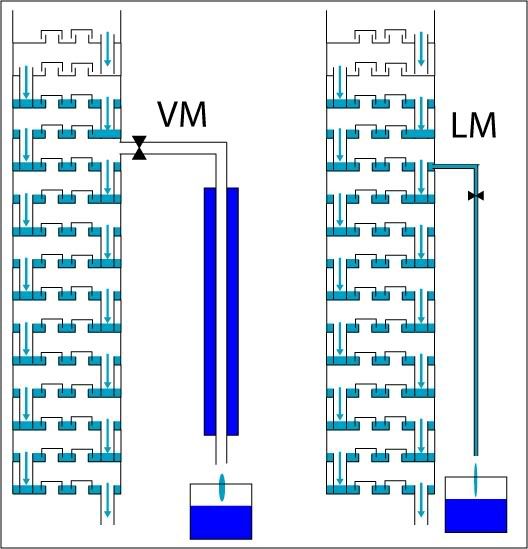
fig 1.
Liquid Management:
With LM the vapor is entirely condensed above the plate or packing the liquid is collected in a reservoir, using a needle valve a % of product is drained of and the rest is retuned as reflux.
Vapor Management:
With VM vapor is removed before the condenser, this is determined by a valve in the take off path before a second condenser which then condenses the vapor for collection.
The remaining vapor in the head rises to the reflux condenser and returns as reflux.
This topic is concentrating on VM so we will forget about LM for now..
How VM Works:
I wanted to use the plate design to demonstrate this particular part of the topic.
Pressure is required to force the vapor to the next plate above; this pressure is caused by the liquid suspended on the plate above it.
By adjusting the take off valve we can bleed a % of the vapors for take off, while still retaining enough pressure for the remaining vapors to rise to the next plate.
>--------------------------------- continued from above
who has the room in there house for a 200M column or $$$ to make 500 plates, so how can we reduce this...
we can replace all the plates above 82c with a reflux condenser.
the reflux condenser is tied in line after the final condenser so cooling liquid is preheated in the final condenser before it enters the reflux condenser this efectivly reduce the amount of plates needed.
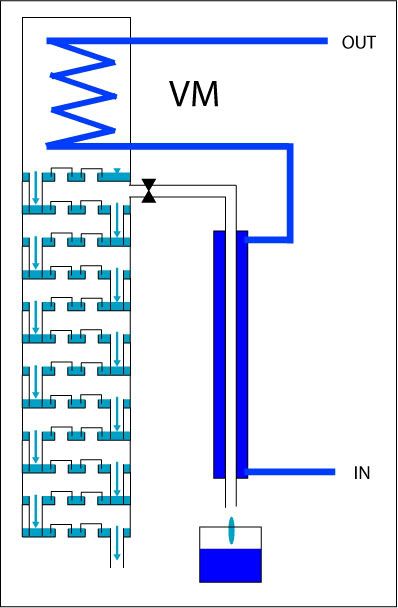
We have found that filling the column with media like rashes rings, glass beads, stainless steel or copper scourers etc will cost effectively produce desired results.
Unfortunately we don’t need to produce thousands of Liters of spirits so from continues production we attach our columns to pots for batch production..
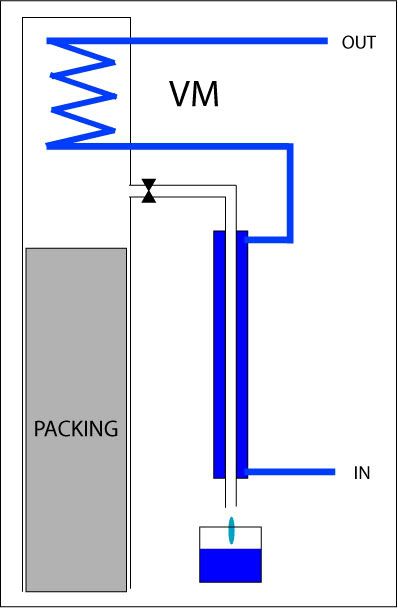
So this is where we are now as far as the design of the VM column goes.
Only problem is that some owners of a VM Column are complaining that it cuts off when reaching tails, so we ask WHY?
This is where I theorise what is going on:
Because we have turned this into a batch process and replaced the plates with a condenser we have introduces variables, How?
First the pot, as the alcohol evaporates we have a temperature and pressure change.
Maybe someone can correct me on this.
More vapors or pressure is generated from lower boiling liquids in this case Ethanol in relation to water per BTU.
As the % of Ethanol to water lowers the reflux sweet spot moves lower down the column lowering the pressure at the take off point resulting in a lower take off.
The final condenser has fewer vapors to condense passing cooler water to the reflux condenser which in turn condenses more reflux returning down the column further lowering pressure at take off eventualy no minimal vapour passes thru for collection.
A comment maid by Minime triggered this idea,
the problem is that you are unable to reduce the amount of reflux by controling the reflux condensor.Yes but we can increase the RR any time by just closing the valve some degree.
so how can we fix this...?
You could use a smaller final condenser, the problem is that its difficult to calculate dimensions that everyone can use with all the variable created by tube dimension, water temperature, flow rate, etc
My sugestion is to introduce CM "Coolant Management"
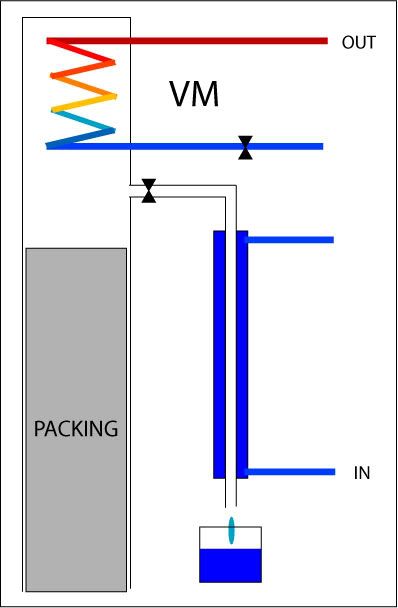
By reducing the water flow to the reflux condensor will increase its temp lowering reflux allowing more vapour pressure to build up and exit via take off.
If this is succesfull the next step is to link this to boiler temp to adjust reflux condensor temp automaticly.
another way of controling the take off is to use a spring loaded pressure valve..
im still looking at the operatio of a VM head so im looking for feedback.
i cant understand why it is said it automaticly adjusts reflux as is.?
can somone shine sime light on things i have over looked or share you opinion on this theroy..
cheers..